
Taste analysis - ASTREE Electronic Tongue
The reliability of the electronic tongue enables you to make products development easier by assessing their taste. This instrument is perfect for avoiding possible health hazards to your panel of testers when evaluating products containing harmful or unpleasant molecules.
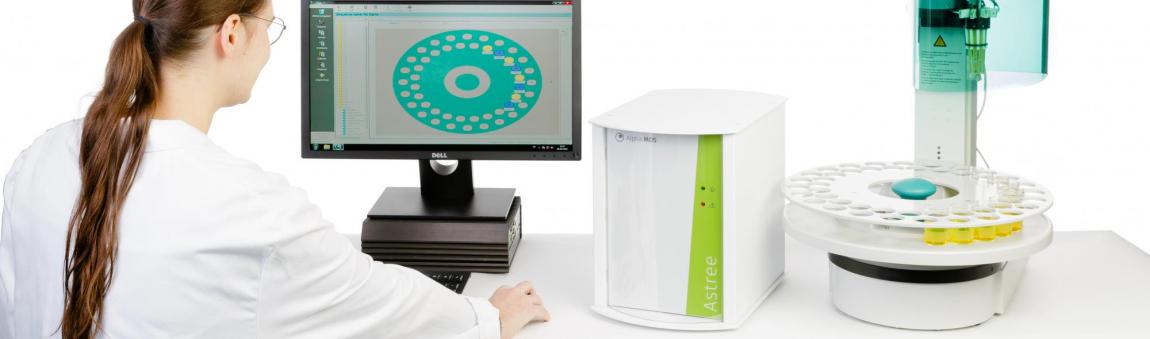
ASTREE,
taste sensors electronic tongue

The benefits of ASTREE electronic tongue
The use of an instrument like the electronic tongue for the sensory analysis of taste allows our customers to:
- Make sensory evaluation more objective within their company thanks to an automated measurement with an instrument
- Control the sensory characteristics of their products thanks to a good knowledge and a possible comparison of taste profiles
- Assure assessors’ safety by avoiding exposing them to potentially dangerous or unpleasant substances.
ASTREE: unique technical performance
Based on a technology of ChemFET liquid sensors and a conductivity measurement, the electronic tongue evaluates the overall taste of liquid products:
- Evaluation of taste fingerprint : the electronic tongue detects all ionic compounds responsible for taste in liquids. With its specific data processing software based on multivariate statistics, the instrument can assess the overall taste profile and compare several similar products.
- Quantitative analysis capabilities: with the electronic tongue sensors it is possible to rank similar samples according to the intensity of some attributes after having built a quantitative model with known samples.
- Objectivity of the measurement for taste analysis: the use of an instrument like the electronic tongue to assess the taste in controlled and automated conditions provides an objective measurement.
- Rapidity and high throughput of analysis : ASTREE electronic tongue autosampler allows to automate an analysis sequence of a set of samples, with a sample analyzed every 3 minutes.
The ASTREE electronic tongue can thus replace the sensory panel for certain routine tests that are unpleasant or pose safety concerns due to the presence of compounds that are potentially harmful to health.
Request Brochure
AlphaSoft,
Sensory Analysis Software
AlphaSoft software operates all Alpha MOS instruments:
- HERACLES electronic nose
- ASTREE electronic tongue
- IRIS electronic eye.
It allows to monitor instruments settings, define analysis methods and sequences, run analysis and perform data acquisition.

It also achieves the data processing of Alpha MOS instruments measurements, using different models based on the application:
- Qualitative models: comparison of several samples on overall odor/taste/visual aspect, samples classification based on a criterion, quality/conformity control, shelf life monitoring
- Quantitative models: prediction of measurable parameters such as a concentration or a sensory attribute intensity.

Data processing modules (statistics packages, AroChemBase) can also be used to compute data from other analytical instruments.
AlphaSoft anticipates maintenance needs and avoids losing time on lab activity.
Thanks to this unique software platform, it is possible to combine HERACLES, ASTREE and IRIS results to have an overall point of view of products sensory features.
APPLICATIONS,
 the electronic tongue for taste analysis
The applications of the electronic tongue for evaluating the taste of products are numerous in the industry because taste attributes composing the sensory profile of products are key factors for their success among consumers. Thus, industrials frequently use taste analysis, during the formulation or the product development steps.
An optimized taste analysis with the electronic tongue
The sensory profile and particularly the taste of products have a strong influence on consumers’ choice and preference. The electronic tongue, by providing objective taste measurements, is a precious tool to help formulate or develop a new product that will appeal to consumers:
-
 Conception of an innovative product with totally unique taste
- Re-development of product (retro-engineering) to change or improve its savour and taste characteristics
- Benchmarking of competitive products based on their sensory profile and their taste attributes
- Change of manufacturing process or ingredients substitution and evaluation of the impact on product taste
- Comparison of different formulations to select the one that best masks an unwanted taste
- Quantitative taste analysis in correlation with a sensory panel.